


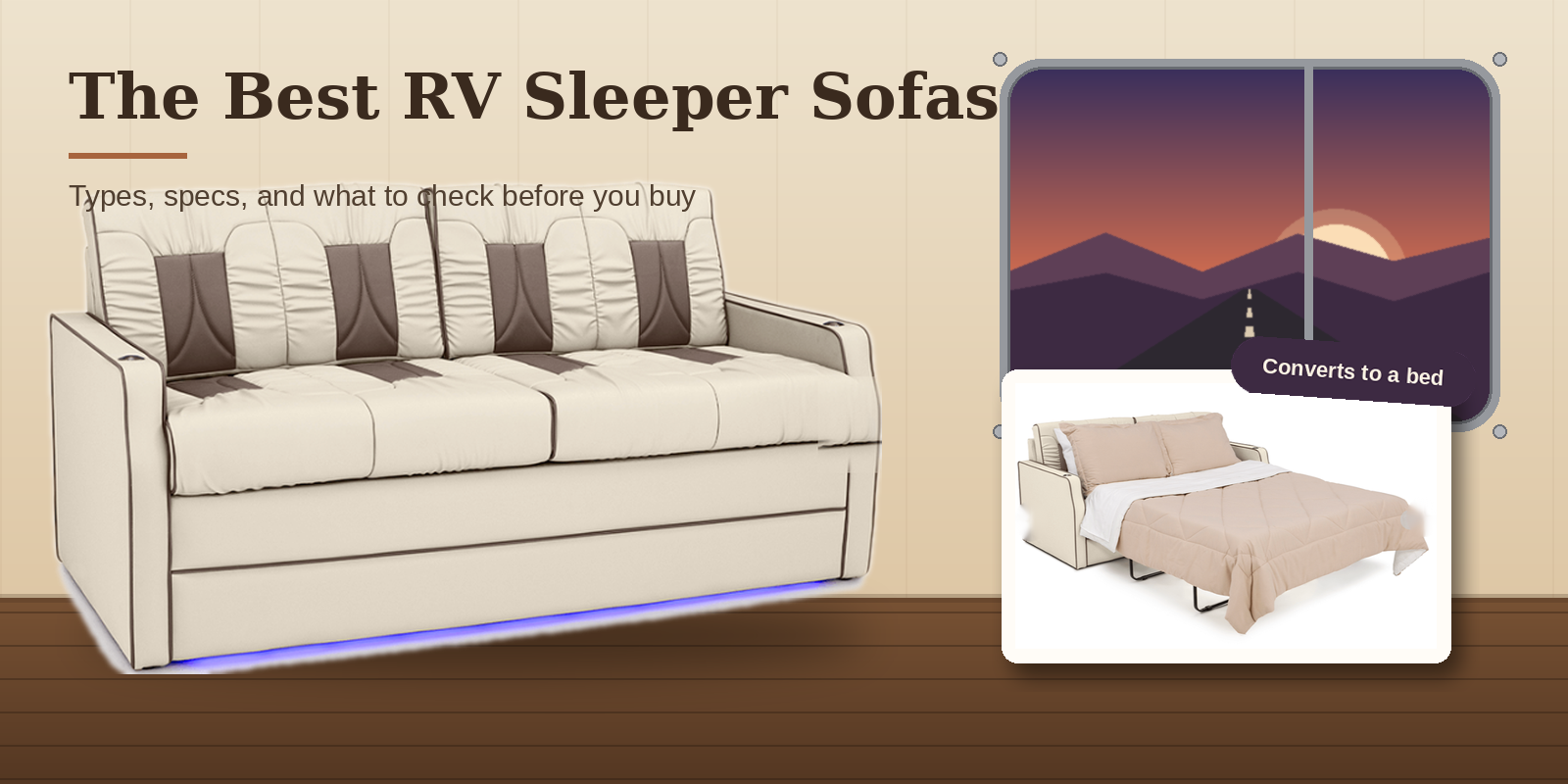
An RV sofa can look perfect in photos and still be the wrong one. It might not fit through the entry door. It might add more weight than your rig can comfortably carry. Or it might fold out into a bed that blocks the aisle and leaves no room to walk past.
This guide covers the main types of RV sleeper sofas, the measurements that decide whether one will fit, what frame and upholstery hold up on the road, and how to measure your current couch before you order a replacement.
The Main Types of RV Sleeper Sofas
Jackknife sofa
The seat and backrest are hinged together. Pull the seat forward and the backrest drops flat, forming a bed from the cushions themselves. With few moving parts, it is usually the lightest and simplest option, and it suits one adult or two kids.
Our Qualitex De Leon jackknife sofas come in three arm styles: armless, SL (removable slide arms) and DX (fixed arms). The armless De Leon opens to a 66" or 72" wide by 51.5" long bed, and its wall-hugger design needs only one inch of clearance from the wall. There is also storage space under the seat.
Hide-a-bed
A folding metal frame with a thin mattress is stored inside the sofa. You remove the seat cushions and pull the frame out. It sleeps two on a proper mattress, but it reaches furthest into the room when open, which makes it the biggest floor plan risk in a narrow coach.
Tri-fold sofa
The sleeping surface folds in three sections that open forward into a flat bed. The Qualitex Dakota tri-fold uses a heavy-duty tubular steel bed frame and zero-wall clearance, so it can sit right against the wall.
Pull-out sofa
A pull-out system extends forward to create a larger sleeping area, much like a residential sleeper. Our Qualitex Prescott, Ridgeline and De Leon PS models use this design with a tubular steel bed frame and zero-wall clearance.
Clickback or click-clack sofa
The backrest locks into several positions with a ratchet, from upright to lounging to fully flat. Clickbacks are low profile and compact, which is why they are common in travel trailers and camper vans. The cushions form the sleeping surface.
The Measurements That Actually Matter
Most fit problems come from measuring the wrong thing. Check these three numbers.
|
||
|
||
|
Here is how a few current Shop4Seats models compare:
| Model | Type | Width options | Bed and wall clearance | Door fit |
| Qualitex De Leon | Jackknife, armless | 66" or 72" | 66" or 72" W x 51.5" L bed, 1" wall clearance | See dimensions PDF |
| Qualitex De Leon SL | Jackknife, removable slide arms | 68" or 74" | 1" wall clearance | See dimensions PDF |
| Qualitex Dakota | Tri-fold | 68" | Zero-wall clearance | Fits a 24" doorway |
| Qualitex Prescott PS | Pull-out | 72" | Zero-wall clearance | Fits a 24" doorway |
| Qualitex Ridgeline PS | Pull-out | 68" | Zero-wall clearance | Fits a 24" doorway |
On the tri-fold and pull-out models, the sofa body is rotated 90 degrees to pass through the door, and the backrest is attached once it is inside.
Why weight matters
Every RV has a Gross Vehicle Weight Rating (GVWR), the most it is designed to weigh fully loaded, including water, gear and passengers. The gap between that rating and what the RV weighs empty is your payload, the weight you can add. Your manufacturer's weight label and owner's manual list both figures.
|
Frame and Fabric: What Holds Up on the Road
Frame
A sofa in an RV lives with constant vibration, bumps, temperature swings and damp mornings. Engineered wood keeps weight down and holds mounting screws well, but it needs to be properly reinforced. Steel is stronger for parts that carry a sleeper's weight, though it adds weight of its own.
Many of our Qualitex sofas use both: reinforced engineered wood for the sofa body and a heavy-duty tubular steel frame for the bed on tri-fold and pull-out models.
Fabric
Residential upholstery is not made for strong sun through large windows, heat in a parked coach or moisture. For RV use, look for:
|
|
|
|
|
|
|
On the De Leon, the Ultimate Leather cover is heavy-duty and commercial grade, with weather and fade protection and a no-peel or crack guarantee. The seat uses 1.8 density high-resilience foam.
Replacing Your Existing RV Sofa
Before you remove anything, take these measurements:
|
||
|
||
|
||
|
||
|
Once you have these numbers, compare them against the listings in our RV sofas and sofa beds range. If you are updating the front of the coach at the same time, our RV captain chairs come in matching Qualitex styles such as De Leon and Trailside.
Frequently Asked Questions
|
What size sofa fits in an RV? There is no single size. Measure the wall space, the entry door at its narrowest point and the aisle depth when the bed is open. Our RV sofa beds come in widths from 66 to 78 inches, so you can match the sofa to your floor plan. |
|
How much does an RV sleeper sofa weigh? It depends on the type and frame. Jackknife sofas are usually the lightest, while sofas with steel bed frames weigh more. Check the listed weight or ask the retailer, then compare it with your RV's cargo carrying capacity. |
|
Can I replace my RV couch with a residential sofa? It is possible, but it often causes problems. Residential sofas may not fit through an RV door, are not built for road vibration, have no mounting points and can be heavier. RV sofas are also made to suit vehicle interiors, including flammability standards such as FMVSS 302. |
|
What's the difference between a jackknife and a hide-a-bed? A jackknife sofa folds flat so the cushions become the bed. A hide-a-bed stores a folding frame and mattress inside the sofa. A hide-a-bed usually sleeps two more comfortably but extends much further into the room when open. |



